


Why The Base Rate Was Held
The Bank of England held Bank Rate at 3.75% because inflation risks remain finely balanced. Energy price uncertainty, global conflict and higher import costs could push inflation higher, while a weaker economy and softer labour market may reduce inflationary pressure.
In simple terms, the Bank did not want to cut too soon and risk reigniting inflation, but it also did not want to increase rates while the economy is already under pressure. This cautious approach keeps mortgage markets sensitive to inflation data, gilt yields and swap rate movements.
Domestic Political Uncertainty Fuels Fresh Concerns
Political uncertainty and rising government borrowing costs are creating fresh concerns for the UK housing market. Higher gilt yields, inflation worries and speculation over future government spending could push swap rates higher, feeding through into fixed-rate mortgage pricing.
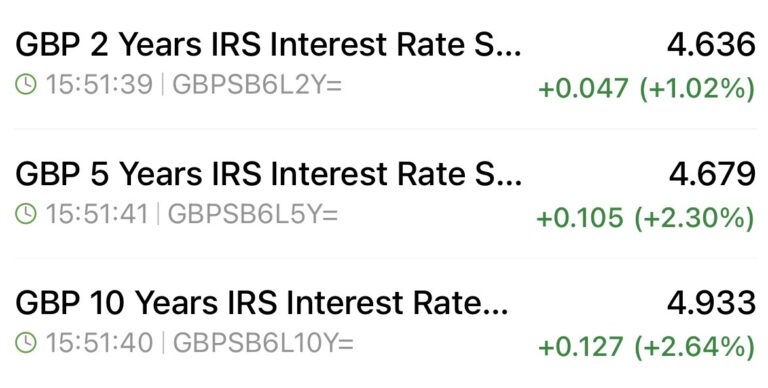
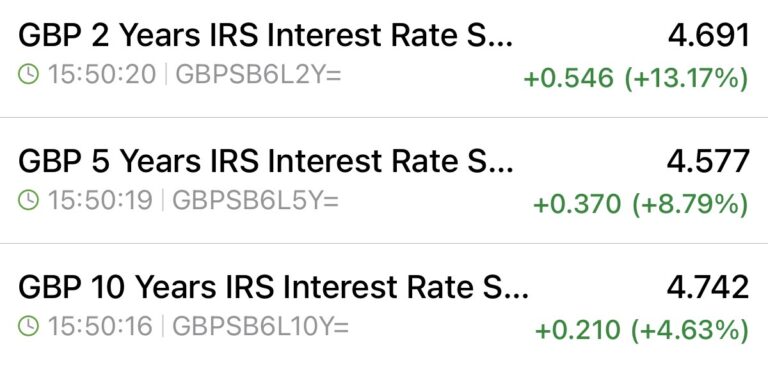
This is already being reflected in swap rate movements. On 20th March, 2-year swaps stood at 4.691%, 5-year swaps at 4.577%, and 10-year swaps at 4.742%. By 15th May, these had changed to 4.636%, 4.679%, and 4.933% respectively. Although 2-year swaps have eased slightly, 5-year and 10-year swaps have increased, showing that longer-term borrowing costs remain under pressure. This matters because lenders use swap rates to price fixed-rate mortgage products. When swap rates rise, lenders’ funding costs increase. This can lead to mortgage products being withdrawn, repriced upwards, or made less competitive.
If borrowing costs continue to rise, this could weaken buyer demand, reduce market activity and place downward pressure on house prices. The key message is simple: mortgage pricing remains closely linked to wider economic confidence, and political or financial instability can quickly affect the rates available to borrowers.
15th May Swaps
20th March Swaps
Compare Mortgage Rates Online
Recent lender activity shows how quickly mortgage products can change when funding costs move. Over the past week, several lenders have adjusted selected residential, buy-to-let, tracker, product transfer and higher loan-to-value products, with some rates reducing while others have been withdrawn, replaced or repriced.
This highlights why borrowers should not assume that a rate seen today will still be available tomorrow. In a volatile market, lenders may change pricing at short notice to reflect swap rates, gilt yields and wider economic uncertainty. For anyone whose mortgage deal is ending soon, the safest approach is to review options early, secure a suitable rate where available, and continue monitoring the market before completion in case a better product becomes available.
You can also use our online mortgage sourcing tool to check the latest deals available. The system provides real-time mortgage results, allowing you to compare products based on your own circumstances before deciding whether to take advice or secure a rate. This can be particularly useful if your current mortgage deal is ending soon, or if you want to understand how recent market movements may affect your borrowing options.
